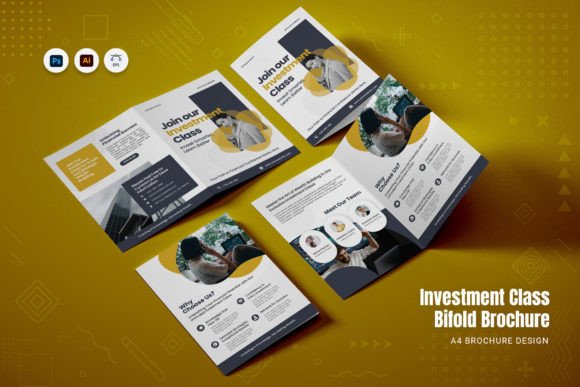
Investment Class Bifold Brochure: A Strategic Tool for Professional Presentation
In the competitive landscape of financial services and business development, the physical presentation of your proposal often dictates the initial perception of your credibility. The Investment Class Bifold Brochure serves as a critical touchpoint in this process, bridging the gap between complex financial data and clear, actionable client understanding. This template is not merely a static document; it is a structured workflow asset designed to streamline the creation of high-quality marketing materials. Whether you are an entrepreneur pitching a new venture, a financial advisor presenting portfolio options, or an educator explaining investment strategies, this tool fits seamlessly into your broader communication strategy.
The core value of the Investment Class Bifold Brochure lies in its balance of aesthetic appeal and functional utility. It allows professionals to share information in an informative and creative way, catering to both marketing objectives and educational needs. By utilizing a pre-structured layout, creators can focus less on the mechanics of design alignment and more on the substance of their message. This shift in focus is essential for maintaining consistency across multiple projects while ensuring that every piece of collateral meets professional printing standards.
Integrating the Template into Your Design Workflow
Effective use of the Investment Class Bifold Brochure begins before the first pixel is placed. Successful implementation requires a phase of preparation where content is gathered, refined, and organized. Because the template is fully layered and well-organized, it demands that users approach the editing process with a clear hierarchy of information. Before opening the file, gather your key metrics, executive summaries, and visual assets. This preparatory step ensures that when you access the mockup elements, you can modify them immediately without disrupting the flow of your work.
The workflow integration is particularly smooth due to the compatibility of the files with industry-standard software. The package includes the main file in Adobe Illustrator (Ai) and Adobe InDesign (INDD) formats. For designers who rely on vector graphics for scalability, the Illustrator version offers precise control over shapes and typography. Conversely, those managing text-heavy documents will find the InDesign version superior for handling paragraph styles and long-form content. This dual-format availability ensures that the template adapts to your specific technical environment, whether you are working alone or collaborating within a larger creative team.
During the execution phase, the "Super Easy to Edit" nature of the template becomes apparent. Users can replace image placeholders with their own branding assets, adjust color palettes to match corporate identity guidelines, and update text blocks using built-in paragraph styles. These styles are pre-configured to maintain typographic consistency, a crucial element for professional documents. Instead of manually adjusting font sizes and leading for every paragraph, the designer applies a style class, ensuring uniformity throughout the brochure. This efficiency reduces the time spent on formatting and minimizes the risk of human error during the final review.
Technical Specifications and Print Readiness
A significant advantage of the Investment Class Bifold Brochure is its adherence to strict print production standards. Many digital templates fail when moved to a professional printing press due to incorrect resolution or missing bleed areas. This template eliminates those risks by being fully print-ready out of the box. It is configured at A4 paper size with a CMYK color mode and 300 DPI resolution. These specifications are non-negotiable for high-quality offset printing, ensuring that colors remain vibrant and images stay sharp upon physical reproduction.
The inclusion of bleed is another critical feature for professional output. Bleed refers to the extra area around the edge of the page that gets trimmed off during the cutting process. Without proper bleed settings, white edges may appear on the final product, which looks unprofessional and undermines the quality of the financial proposal. By having bleed included by default, the template guarantees that full-bleed images and background colors extend correctly to the edge of the paper. This attention to detail saves hours of troubleshooting with printers and prevents costly reprints.
Furthermore, the use of free fonts ensures that there are no licensing barriers when distributing the files or sending them to third-party printers. Often, proprietary fonts cause issues if the recipient does not have the same license installed. With built-in free fonts, the template remains accessible and editable for anyone involved in the production chain, from the primary designer to the external print vendor. This accessibility fosters smoother collaboration and reduces friction in the supply chain.
Strategic Use Cases Across Industries
The versatility of the Investment Class Bifold Brochure extends beyond traditional finance. Its clean and modern layout makes it suitable for a wide range of sectors where trust and clarity are paramount. Financial advisors can use it to outline retirement planning strategies, breaking down complex fee structures into digestible sections. Real estate developers might adapt the template to showcase property investment opportunities, utilizing the image placeholders for architectural renders and location maps.
Educators and consultants also benefit from this format. An instructor creating course materials can leverage the bifold structure to provide students with a concise summary of investment principles. The ability to organize information into distinct panels allows for a logical progression of ideas, guiding the reader from problem identification to solution presentation. Similarly, small business owners can use the brochure as a pitch deck supplement, offering investors a tangible takeaway after a meeting. The physical presence of the brochure reinforces the verbal pitch and provides a reference point for decision-making.
For marketers and bloggers, the template serves as a lead magnet or a premium resource. Instead of relying solely on digital downloads, a printed brochure adds a layer of tangibility that digital files cannot replicate. When distributed at networking events or conferences, the high-quality finish of the Investment Class Bifold Brochure signals professionalism and dedication to quality. It transforms a simple informational sheet into a brand-building asset that clients are more likely to keep and refer back to.
Optimizing Content and Visual Hierarchy
To maximize the impact of the brochure, content must be curated with the same precision as the design. The bifold format offers limited space, requiring a disciplined approach to copywriting. Every sentence should serve a purpose, driving the reader toward a specific action or understanding. The template's stylish web-inspired layout encourages the use of whitespace, which helps prevent cognitive overload. By grouping related information together and using strong headings, the designer guides the reader's eye naturally through the document.
Visual hierarchy plays a central role in how the information is consumed. The template provides designated areas for headlines, subheads, body text, and imagery. Utilizing these zones effectively ensures that the most important data points—such as return on investment figures or key benefits—are immediately visible. The use of contrasting colors and bold typography within the built-in styles helps distinguish critical information from supporting details. This visual organization supports the reader in quickly scanning the document and finding the answers they need.
Image selection is equally important. Since the template includes image placeholders, users should select high-resolution photographs that align with the tone of the investment class being presented. Generic stock photos can dilute the message, whereas custom imagery or carefully selected authentic visuals build trust. The 300 DPI requirement means that even small images must be sourced with care to avoid pixelation. This commitment to visual quality reflects directly on the perceived value of the investment opportunity itself.
Long-Term Value and Adaptability
The true power of the Investment Class Bifold Brochure lies in its long-term adaptability. Unlike one-off designs, this template is built to evolve with your business. As market conditions change or new products are launched, the fully layered structure allows for rapid updates without starting from scratch. You can swap out old statistics, refresh the color scheme to match a rebranding effort, or update contact information in minutes. This agility ensures that your marketing materials remain current and relevant without incurring the cost of hiring a designer for every minor revision.
Maintaining a library of such templates contributes to overall operational efficiency. When a standardized format is established, the team spends less time debating design choices and more time executing the strategy. The consistent look and feel across different brochures reinforce brand recognition and build familiarity with the audience. Over time, this consistency becomes a competitive advantage, distinguishing your firm from competitors who rely on disjointed or inconsistent collateral.
Ultimately, the Investment Class Bifold Brochure is more than a file; it is a component of a robust communication ecosystem. It interacts with digital platforms, sales meetings, and educational sessions to create a cohesive narrative. By integrating this tool into your workflow, you ensure that every interaction with a potential client is backed by a professional, polished, and persuasive presentation. The combination of ease of use, technical precision, and strategic flexibility makes it an indispensable asset for anyone serious about communicating value in the investment sector.